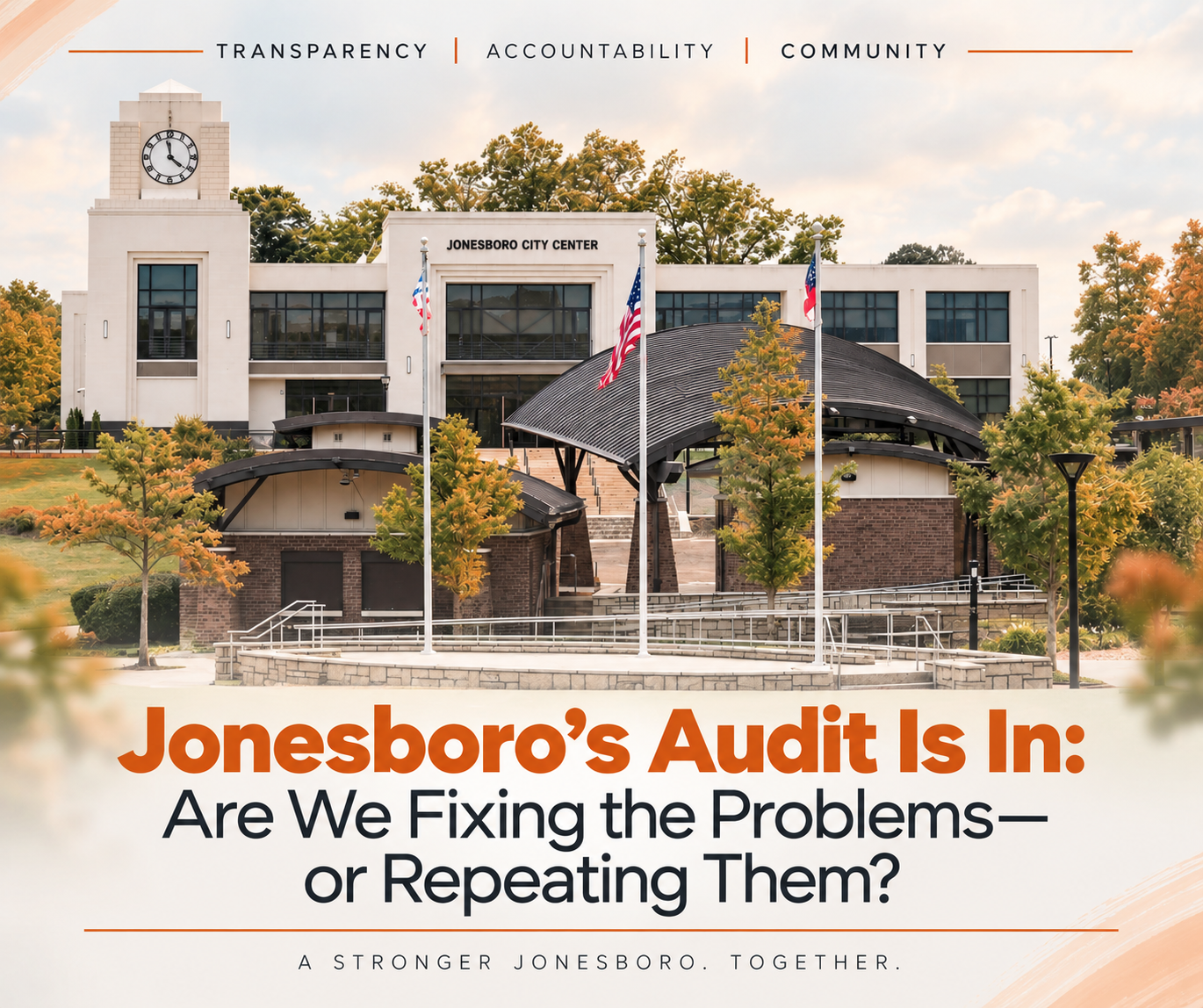
Jonesboro’s 2024 Audit: The Good, the Bad & What Happens Next
If you heard the words “material weakness” during Tuesday’s audit presentation and thought, Wait…what exactly does that mean? — this one is for you.
I went through the 2024 audit, and I want to break it down without all the accounting language.
Here’s the headline:
Jonesboro did not “fail” its audit. But the audit absolutely identified financial processes that need to be fixed.
And some of the findings are serious.
First, the good news.
Jonesboro received an unmodified audit opinion. In simple terms, after the necessary audit adjustments were made, the auditors concluded that the City’s final financial statements fairly presented its finances in all material respects.
The audit also shows the City’s overall net position increased by approximately $1.7 million, while long-term debt decreased by approximately $1.5 million during 2024.
Good.
Now let’s talk about what needs work.
Finding #1: MATERIAL WEAKNESS
This is the big one.
A material weakness means the City’s internal financial controls were not strong enough to reasonably ensure that a significant financial reporting error would be prevented—or caught and corrected—in a timely manner.
Does that mean the auditors found fraud? No.
Does it mean they found money missing? No.
But does it mean our financial safeguards need serious improvement? Absolutely.
The auditors found that the financial statements initially provided by management required multiple material adjustments across multiple areas before they were materially correct and not misleading.
Why?
The audit points to insufficient governmental-accounting expertise, inadequate training and staffing, reliance on the auditors to identify year-end adjustments, and a lack of adequate independent review procedures.
Put simply:
The auditors were catching significant accounting issues that stronger internal controls should have caught before the auditors arrived.
So, What Are “Internal Controls”?
Think of internal controls as financial checks and balances.
Did we reconcile the bank account?
Does the general ledger match?
Did we stay within the budget?
Did Council approve a required budget amendment?
Did someone independently review the work?
Are procurement procedures being followed?
Is Council receiving accurate financial reports?
Those are internal controls.
And according to this audit, ours needed strengthening.
Finding #2: Spending Above the Approved Budget
This finding caught my attention.
The auditors found expenditures above appropriations in several areas without the required budget amendments being approved by City Council.
The audit specifically says management was not informing City Council of all line items in the annual budget that needed to be amended by year-end.
The auditors determined that this resulted in noncompliance with City policy and Georgia law.
Translation:
Council approves the budget. When spending requires an increase in appropriations, Council approval of the amendment is part of the process.
That is a check and balance.
And Then Came Tuesday Night.
This is where the 2024 audit starts connecting to questions we are asking today.
During the same September 8 Council meeting, Councilwoman Curney presented a list of accounting transaction concerns involving our event line items. Her presentation raised concerns about spending that had gone more than $50,000 over budget and whether the appropriate information and approvals had been presented to Council.
That information is not a finding contained in the attached 2024 audit, so I want to be clear about that distinction.
But it raises an important question in light of what the auditors already told us:
Have we actually fixed the underlying problem?
The 2024 audit found expenditures exceeding appropriations without Council-approved amendments.
Now, in 2026, Council is again asking questions about spending beyond budgeted amounts and whether Council was properly informed.
That is exactly why internal controls matter.
One occurrence may be a mistake.
But when similar breakdowns continue, we have to start asking whether we are looking at a repetitive pattern in the process.
And if we do not strengthen those controls now, we risk seeing the same type of finding in future audits.
Finding #3: The Audit Was Late
Georgia requires local-government audits to be completed and forwarded to the State Auditor within 180 days after the fiscal year ends.
Jonesboro’s 2024 audit missed that deadline.
Again, the auditors pointed to insufficient accounting and finance personnel with the necessary knowledge and experience.
And this isn’t just paperwork.
The auditors warn that failure to comply with state reporting requirements can impact the City’s ability to receive grant funding.
That needs to be corrected.
But Wait—There’s More.
Page 18 may be one of the most important pages in this entire report.
The auditors gave Jonesboro six additional recommendations for strengthening our financial systems.
In plain English:
- Get our SPLOST budgets and cost estimates in order and bring updated or amended estimates to Council for approval.
- Reconcile Pool Cash monthly so we know what belongs to each City fund.
- Clean up outstanding bank reconciliation items so the City’s books agree with the bank.
- Keep an updated inventory of City assets such as land, buildings, vehicles and equipment.
- Update the City’s capital-asset policy, including the threshold used to classify purchases as capital assets.
- Give Council timely and accurate monthly financial reports with budget comparisons.
That last one deserves to stand alone:
The auditors specifically reported that City Council was not receiving timely and accurate monthly financial reports.
How can Council effectively monitor a multimillion-dollar budget without timely and accurate financial information?
WE CAN’T.
And Here Is Where It Gets Complicated.
Jonesboro operates under a strong-mayor system.
Council exercises its legislative authority. We approve budgets, adopt policies and provide oversight.
But Council does not run the City’s day-to-day administration.
As I made clear during Tuesday’s Council meeting, Council can adopt the policy. The administration has to execute and enforce it.
And that’s where I believe we have reached an important crossroads.
What happens when the policy already exists—but it isn’t being followed?
What happens when we have procurement procedures, budgetary controls and internal controls on paper, but Council continues discovering transactions after the fact?
What happens when an independent auditor tells us management did not bring necessary budget amendments to Council, and two years later Council members are still raising concerns about whether spending was properly presented?
At some point, the question changes from:
“Do we have a policy?”
to:
“Who is responsible for enforcing it?”
Because a policy sitting in a binder is not an internal control.
A control works only when it is actually followed.
So…Are We Improving?
That’s the question.
The City’s responses to the audit say:
Controls will be put in place.
Processes will be put in place.
Future deadlines will be met.
Good.
But remember:
This is the 2024 audit being presented in 2026.
So now we have to move beyond promises.
Were the controls actually put in place, and if these controls exist today, who is making sure they are being followed?
Where Does Council Go From Here?
This is where oversight matters.
Council cannot and should not run the Finance Department.
But Council can strengthen reporting requirements, require timely financial information, monitor corrective actions, insist upon compliance with adopted policies and use its legislative authority when existing controls are not working.
And when Council discovers that a policy is repeatedly not being followed, we have a responsibility to address it.
Because the bottom line is simple:
A procurement policy only works when we follow it.
A budget only works when we stay within it—or properly amend it.
An internal control only works when someone actually performs it.
And oversight only works when Council has accurate information.
The 2024 audit gave us the warning signs.
What Councilwoman Curney presented Tuesday raises the question of whether some of those underlying concerns are still with us.
If we don’t strengthen our controls, we cannot be surprised when the same problems show up again.
For me, this isn’t about pointing fingers backward.
It’s about answering three questions moving forward:
What went wrong?
Did we fix it?
And who is accountable for making sure it doesn’t keep happening?
Jonesboro is growing.
Our systems and our staff have to grow up with us.
Read the Audit for Yourself
Transparency means you shouldn’t have to take my word for it. I encourage every resident to review the report, read the findings, and see the details for yourself.
Want to read the full 2024 audit presentation? You can download and review it here:
Download the City of Jonesboro 2024 Audit Report
Stay informed. Read the documents. Ask the questions. Accountability works best when the community is engaged.
Councilwoman Santia Fox 🧡
The Jonesboro Bridge
Reshaping One Jonesboro
#TheJonesboroBridge #ReshapingOneJonesboro #TransparencyMatters #Accountability #GoodGovernance #JonesboroGA